This guide contains all content and hyperlinks related to Navigating Revised Compensation Policies from the March 2024 and September 2024 Administrators Forums, Office for Academic Personnel & Faculty (APF).
Why Are We Talking About This?
In 2022–23, UW Internal Audit completed a review of policies and processes related to additional compensation for faculty. The audit identified six categories (“findings”) where internal controls were insufficient to ensure compliance with policy.
- Two findings were classified as high risk
- Four findings were classified as medium risk
Audit Findings Summary
The audit identified inconsistencies and/or lack of guidance in the following areas, and recommended actions to:
- Standardize terms and descriptions
- Clarify expectations, limits, and exemptions
- Explore feasibility of simplifying related processes and mechanisms
- Bolster internal controls
- Ensure consistency across websites and other resources
Specifically, the audit identified gaps in:
- Additional compensation policies, procedures, terms, and definitions
- How additional compensation is calculated
- Documentation required to request and approve additional compensation
- Coding of additional compensation in Workday
- Requirements for advance approval of additional compensation
UW Response to Audit Findings
- UW Internal Audit issued formal recommendations to address each finding.
- The Office for Academic Personnel & Faculty (APF), acting on behalf of UW, was charged with:
- Responding to the audit recommendations
- Committing to a plan of action
- UW committed to deliver on these commitments by July 15, 2024.
Executive Order 59 (EO 59)
Executive Order 59 (EO 59) governs additional compensation for faculty. It was revised in June 2024 and serves as a model for additional compensation for librarians and academic staff, except where collective bargaining agreements or other UW policies apply.
A central corrective action was the review, clarification, and revision of Executive Order 59. The draft revision:
- Was supported by the Provost and the President
- Was presented to the Board of Deans and Chancellors, where it received broad support
- Was reviewed by the Faculty Senate, whose comments were reviewed by the President prior to finalization
Policy Clarifications Under Revised EO 59
EO 59 was revised to:
Define additional compensation:
- “A category of faculty compensation provided to reflect a significant expansion of duties necessary to maintain essential University operations and the University’s standard of excellence.”
Set expectations:
- “Prior to awarding additional compensation, every effort will be made to schedule all University-related faculty work as a part of normal duties.”
Unify terminology:
- All types of extra pay are unified under a single system-agnostic term: “Additional compensation”
Require workload documentation:
- Deans and chancellors must establish and communicate standard workload distributions for faculty
- Academic units must adjust workload as the first strategy when addressing overload teaching or overload service
- Additional compensation is permitted only when there is a significant expansion of duties beyond or distinct from the regularly assigned workload
Compensation Limits and Approval Authority
- Total additional compensation is limited to 25% of a faculty member’s monthly base salary, per month
- Dean/Chancellor: authorized to approve additional compensation up to the 25% limit
- Provost: required for compensation above 25% of monthly base salary (submit to VPAP@uw.edu)
Key reminders:
- The 25% threshold applies per month, not per request
- Approval must occur before work begins
- Initiate the Workday process approximately 1 month in advance
Exemptions from EO 59
The following are not considered additional compensation under EO 59 and are exempt from the 25% monthly cap:
- Administrative Duty Supplements (ADS)
- Clinical Coverage Overload payments
- Practice plans (UWP, CUMG, Dentistry)
- Compensation tied to an academic honor (e.g., endowed professorship, endowment supplements, outstanding teaching awards)
- Non-effort-based compensation (e.g., relocation incentives, mobile service agreements)
- Reimbursements allowed by UW policy
Approved outside work per Executive Order 57 (EO 57) — Outside Work for Compensation approved through Form 1460
The following compensation mechanisms are not changing and remain exempt from EO 59:
- Endowed supplements (ENS)
- Relocation incentive payments
- Moving allowances
- Other reimbursements
- CBA-mandated stipends or one-time payments
Compensation Mechanisms: Moving Away from Period Activity Pay
Previous Landscape (Internal Audit Concern)
The previous landscape had too many mechanisms with insufficient clarity:
- 13 Period Activity Pay (PAP) types for academic personnel
- 16 One-Time Payment types
- Administrative Duty Supplements (ADS)
Issues: lack of clarity, distinguishing characteristics, and transparency.
New / Revised Allowance Compensation Plans
APF is moving away from PAP toward clearer allowance mechanisms. The new and revised plans are:
- Non-Faculty Teaching Allowance (NTA) — New
- Temporary Pay Supplement (TPS) — New
- Clinical Coverage Overload (CCO) — New
- Administrative Duty Supplement (ADS) — Revised
These allowance compensation plans appear on the worker’s Compensation tab in Workday and are defined on APF’s Additional Compensation page.
PAP to New Allowance Mapping
Use the following replacements when transitioning from PAP:
- PA07 — Emergency Instructional Coverage → TPS
- PA10 — Executive Education → TPS
- PA13 — Other Activity (Academic) → TPS
- PA14 — Teaching for Credit (Pro Staff) → NTA
- PA017 — Excess Compensation → TPS
- PA26 — Teaching for Credit (Other Staff Exempt Civil Service) → NTA
- Clinical Coverage Overload (One-Time Payment) → CCO (TPS)
Key Impacts of Moving Away From PAP
- NTA, TPS, and CCO show on worker’s compensation tab
- Requests must be initiated by the employee’s home unit
- PAP and One-Time Payments remain available only when:
- Required by CBA
- Activities do not fit NTA, TPS, CCO, or ADS
- PAP should be used sparingly going forward
Compensation Plan Details
Non-Faculty Teaching Allowance (NTA)
Key Features
- For UW personnel whose primary role is not faculty, teaching a credit-bearing course
- Subject to EO 59 and 25% threshold
- Requires start and end dates in Workday (aligned to a single quarter)
- Routes to supervisor → HCM Ops → OAP (if > 25%)
Limitations
- Credit-based courses only
- One course per academic year per person
- Academic appointment must be in place
- Additional courses require FTE adjustment and faculty appointment
Temporary Pay Supplement (TPS)
Key Features
- For temporary duties not accommodated via workload adjustment
- Examples: overload teaching, project work, short-term leadership roles
- Subject to EO 59 and 25% threshold
- Requires start and end dates (end date ≤ 2 years out)
- Can be renewed or extended
- Approved by dean/chancellor unless over 25%
Clinical Coverage Overload (CCO)
Key Features
- For faculty with regular clinical duties taking on additional clinical work
- Exempt from EO 59 and 25% threshold
- Used when spanning multiple pay periods
- Requires start/end dates (typically ≤ academic year)
- Approved by dean/chancellor
Administrative Duty Supplement (ADS)
Key Features
- For specific administrative work only
- Exempt from EO 59 and 25% threshold
- Requires start/end dates (≤ 5 years)
- Requires an administrative academic appointment
- Included in Institutional Base Salary
- Approved by dean/chancellor
ADS-Eligible Appointments (Examples)
- Chair, Director, Dean, Chancellor (including Acting/Interim roles)
- Associate / Assistant / Vice roles
- Dean of University Libraries and related roles
- Medical Director (new)
- Center / Institute Director (new)
- Major Unit or Program Administrator (new)
Internal Controls, Workday & Approvals
Workday validations include:
- Eligibility checks
- 25% threshold validation
- Required context prompts
- Automatic routing to appropriate approver
APF is also:
- Developing new, more intuitive Workday reason codes
- Planning Workday validation rules, including automated checks against the 25% cap
- Creating detailed guidance with clear descriptions of reason codes and terminology, direct links to applicable policies, and examples of appropriate and inappropriate use
- Partnering with UW-IT to explore options for transitioning existing additional compensation into the new model to reduce administrative burden
Compliance Indicators
- Administrative appointments have ≤ 5-year end dates
- ADS holders have valid administrative appointments
- ADS and appointment end dates align
- PAP converted to allowance plans by June 30, 2025
Decision Trees
ADS Compliance Decision Tree
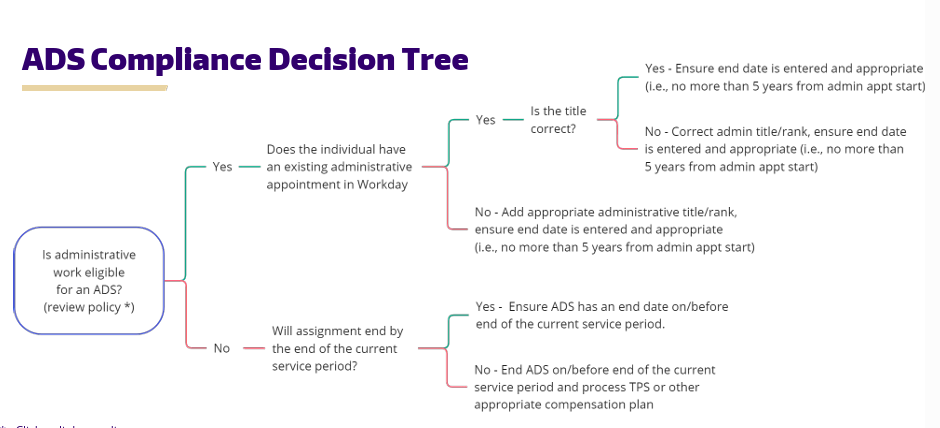
This flowchart guides users through steps to ensure compliance for Administrative Duty Supplement (ADS) assignments:
- Step 1: Is administrative work eligible for an ADS?
- If YES → Step 2: Does the individual have an existing administrative appointment in Workday?
- If YES: Is the title correct? Ensure end date ≤ 5 years from admin appointment start.
- If NO: Add the appropriate administrative title/rank and ensure end date ≤ 5 years from start.
- If NO → Step 3: Will the assignment end by the end of the current service period?
- If YES: Ensure ADS end date is on or before end of current service period.
- If NO: End the ADS on or before end of current service period and process TPS or another appropriate compensation plan.
- If YES → Step 2: Does the individual have an existing administrative appointment in Workday?
PAP Compliance Decision Tree
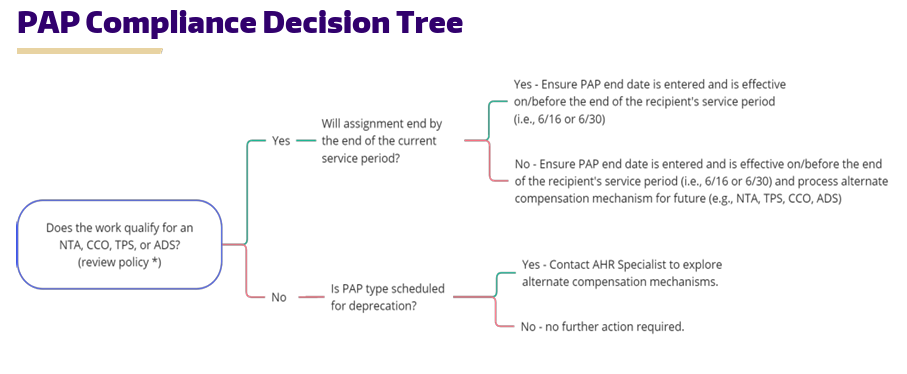
This flowchart guides users through steps to ensure compliance for PAP (Period Activity Pay) assignments:
- Step 1: Does the work qualify for an NTA, CCO, TPS, or ADS?
- If YES → Step 2: Will the assignment end by end of the current service period?
- If YES: Ensure PAP end date is on or before end of recipient’s service period (6/16 or 6/30).
- If NO: Ensure PAP end date is on or before end of service period, and process an alternate compensation mechanism for the future (e.g., NTA, TPS, CCO, ADS).
- If NO → Step 3: Is PAP type scheduled for deprecation?
- If YES: Contact an AHR Specialist to explore alternate compensation mechanisms.
- If NO: No further action required.
- If YES → Step 2: Will the assignment end by end of the current service period?
How Administrators and Units Can Prepare
- Assist leadership in documenting standard workload distributions and additional compensation calculation methodologies
- Be mindful of the 25% cap — evaluate whether work can be addressed through a workload adjustment
- Review which administrative roles qualify as principal administrative appointments: Appointments Requiring Board Approval
- Monitor APF’s eDigest for ongoing updates, training, and implementation resources
Q&A Highlights (September 10, 2024 Live Session)
Q: What about additional compensation over the summer for those on a 9-month service period?
A: If the employee is on a 9-month service period, the summer activities should be compensated first through FTE. You should not process additional compensation until the individual’s FTE has been fully leveraged. If their summer effort will exceed their regular FTE (i.e., roster percent), then additional compensation may be appropriate. Just as during the regular academic year, additional compensation during the summer that exceeds the 25% threshold would route to OAP for review and approval.
Q: If our unit has a per-course/credit flat rate for staff who teach one course through a Lecturer Part-Time Temporary appointment, and that flat rate is more than 25% of the pro-staff employee’s base rate, will the Non-Faculty Teaching Allowance (NTA) request be denied?
A: Not necessarily. NTA requests that exceed the 25% threshold will route to OAP for review. The unit should provide context and a rationale in the process notes. This will help OAP quickly assess whether exceeding the threshold is appropriate.
Q: What if an individual has multiple Temporary Pay Supplements (TPS)? How does that work in Workday?
A: Workday shows a single TPS amount on the Worker’s compensation tab. If multiple TPS have been approved, that TPS amount reflects the cumulative total that is active at that point in time. If one TPS should end and another continue, the unit will have to update the TPS amount and end date accordingly. To get detail on individual TPS approvals, you can review the employee’s compensation history and Comments on individual TPS transactions.
Q: What compensation plan should we use if we want to provide additional compensation to a faculty member who leads a center that is not on the Office of Research Organized Research Unit list?
A: It depends. If the individual meets any of the criteria for an ADS, you could provide an ADS. If they don’t meet any of the ADS criteria, you could use TPS. Remember, though, the first course of action is to explore the feasibility of a workload adjustment.
Q: When I processed Period Activity Pay, I could assign costing different from the individual’s regular base costing. Will I still be able to do that when processing an NTA, ADS, TPS, or CCO?
A: Yes. You perform the Assign Costing Allocation business process after you have assigned the allowance.
Related Resources
- Additional Compensation — APF Policy Page
- Executive Order 59 — Additional Compensation to Faculty
- Executive Order 57 — Outside Professional Work Policy
- Academic Titles Requiring Board of Regents Approval
- Retention Salary Adjustment Requests
- Visa Fees
- APF Training Calendar
- Office of Research — Organized Research Unit List
- Provost-level submission contact: VPAP@uw.edu
- APF eDigest: monitor for ongoing updates, training, and implementation resources